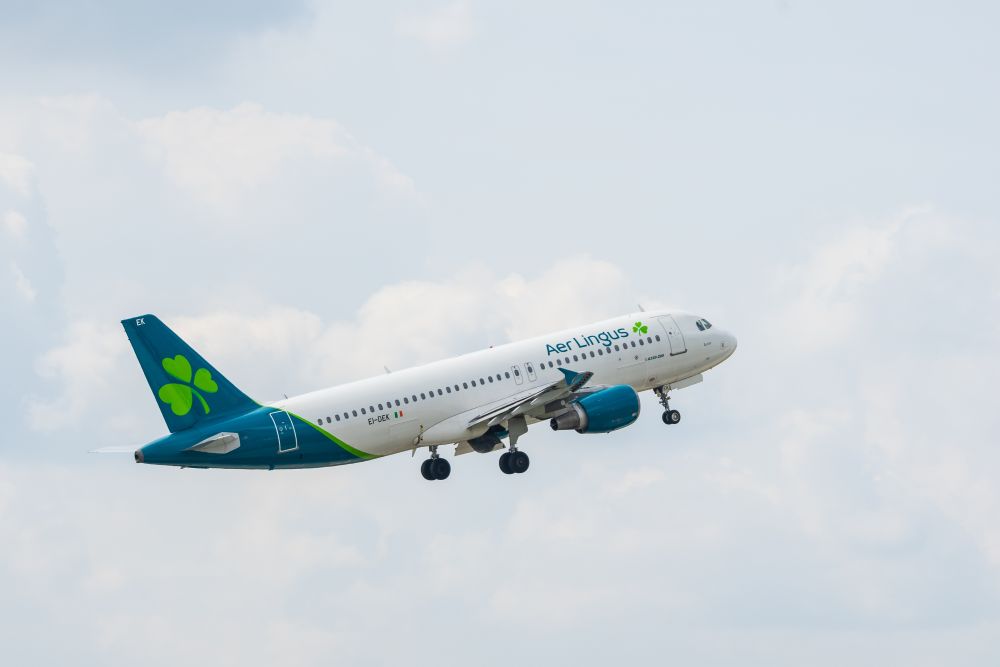

Aer Lingus passengers will soon be able to enjoy free high-speed Wi-Fi on board, thanks to a new partnership between its parent company, International Airlines Group (IAG), and Elon Musk’s Starlink satellite network. The rollout will begin within the next 12 months, with all Aer Lingus aircraft serving US and European routes expected to have the service available by next year.
The move marks a significant step forward in in-flight connectivity for Irish passengers, offering speeds comparable to home broadband. The service will use Starlink’s low Earth orbit satellite network, which provides download speeds of between 150 and 450 megabits per second and upload speeds of 20 to 70 megabits per second.
“This will allow customers to stay connected in the skies with download and upload speeds as good or better than home connectivity, enabling fast downloads, streaming and online gaming for customers on IAG airlines,” IAG said in a statement announcing the rollout.
The IAG–Starlink partnership will bring the technology to more than 500 aircraft across Aer Lingus, British Airways, Iberia, Vueling, and Level, covering both short-haul European flights and long-haul transatlantic routes. The first aircraft equipped with Starlink Wi-Fi are expected to go live in early 2026, with the rollout continuing across IAG’s fleet of roughly 600 aircraft.
IAG Chief Executive Luis Gallego said the move reflects growing customer expectations for seamless connectivity while travelling. “Staying connected in the skies is increasingly important to our airlines’ customers. The introduction of high-speed Wi-Fi from Starlink will transform onboard connectivity, improving both the connection speed and reliability for customers,” he said. “Customers from all IAG airlines will be able to benefit from the service from next year.”
The partnership puts Aer Lingus among a growing number of major global carriers adopting Starlink technology, joining Air France-KLM, Virgin Atlantic, and other airlines that have announced similar agreements. The new network will enable passengers to stream, game, and work online during their flights with minimal lag — a major improvement on the slower, often unreliable systems currently offered by many airlines.
The Wi-Fi service will be free to all Aer Lingus customers, marking a first for the airline and setting a new standard for passenger experience in Europe. The upgrade is part of a wider innovation drive within IAG, which includes the use of artificial intelligence to optimise engine maintenance and the establishment of the IAGi venturing fund to invest in technology startups and scale-ups that support the group’s digital transformation.
The announcement coincides with a strong financial performance for Aer Lingus. The airline reported an operating profit of €170 million for the third quarter of 2025, a 22% increase — or €31 million higher than the same period last year. The company attributed the growth to “solid revenue performance” and favourable fuel pricing, despite industrial action earlier in the year.
Chief Executive Lynne Embleton said the airline remains confident about the market outlook, even amid increasing competition. “I don’t have concerns over the market at all, but there is a lot of capacity coming into Ireland that we need to absorb,” she said. “That level of growth is over and above what you would normally expect.”
Embleton confirmed that Aer Lingus expects fares to remain broadly flat into next year, as competition among carriers serving Ireland intensifies.
The addition of free, high-speed Wi-Fi is expected to give Aer Lingus a competitive edge in the transatlantic and European markets, particularly for business and long-haul travellers. Industry analysts say that as more airlines turn to next-generation satellite connectivity, passengers are increasingly viewing reliable onboard internet as an essential feature rather than a luxury.
With Starlink technology promising near-instant connectivity and uninterrupted streaming even over oceans, Aer Lingus’s decision signals a major leap forward in passenger experience — one that could redefine expectations for in-flight service across the airline industry.