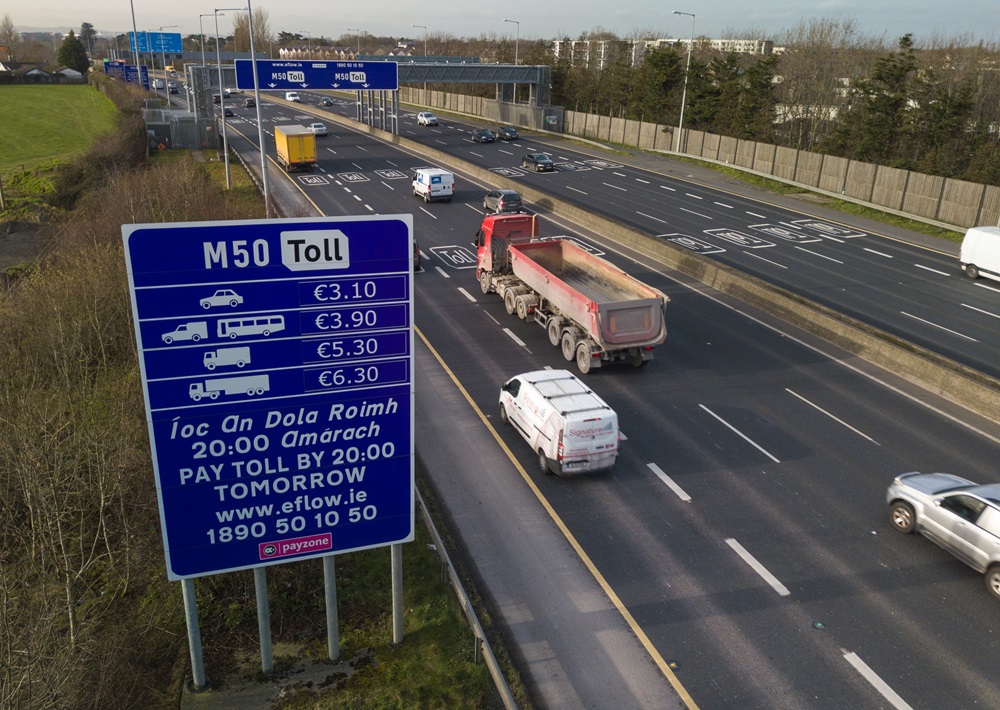

Data from Transport Infrastructure Ireland (TII) shows that toll booths generated almost half a billion euro in revenue in 2025, with the heavily used M50 accounting for more than 40% of the total.
Records released under the Freedom of Information Act also revealed that €445,000 worth of tolls went unpaid nationwide last year. However, TII declined to provide a detailed breakdown of which roads recorded the highest levels of unpaid tolls, citing security concerns.
Despite its reputation for near-daily congestion, Dublin’s ring road remains one of the country’s most lucrative toll routes. The M50 alone generated €216.6 million in revenue during 2025.
TII records also show that €5.93 million in bad debt linked to M50 tolls was written off.
Elsewhere, motorists using the M1 motorway, which connects Dublin with the border, paid a total of €52.4 million in toll charges last year. Figures show that around €102,000 in change was left behind at toll plazas along that route.
The M4 motorway, linking Dublin with the west of the country, brought in €49.45 million in toll revenue. Overpayments on that road were significantly lower, with about €9,000 left unclaimed.
The Dublin Port Tunnel was the next highest earner, generating €35.4 million from motorists using the route to travel in and out of the capital. Around €27,000 in overpaid tolls was left behind there.
Further figures show that the Limerick Tunnel produced almost €31 million in income, with roughly €31,000 in change uncollected.
Both the M3 motorway and the M7/M8 route recorded toll revenues of about €29 million each. Combined, motorists left approximately €65,000 in change at toll plazas on those routes.
Additional toll income included €15.62 million collected on the N6, €24.7 million on the M8, and €14.6 million on the N25.
Across all toll roads, electronic tolling systems and tag payments accounted for around two-thirds of transactions.
They said figures for the East-Link toll bridge in Dublin’s Docklands were not available because it falls under the responsibility of Dublin City Council.
A TII spokesman added: "The Government identified a role for Public Private Partnerships (PPPs) as a means of delivering critical public infrastructure.
"It was a Government policy decision to assist with the delivery of the new motorways.
"The revenues collected on these toll roads are collected by the relevant PPP company and are generally used … to repay loans borrowed to finance construction of the road and to fund ongoing operations and maintenance activities."
Reporting by Ken Foxe, RTÉ.