
Dublin Chamber has called on those involved in ongoing fuel price protests to “engage constructively and end disruption”, as demonstrations continue to cause widespread transport and economic impact across Dublin and the wider country.
The appeal comes as the capital enters another day of significant disruption, with knock-on effects felt across Kildare, Meath and Wicklow, and coordinated protests continuing nationwide in counties including Cork, Limerick, Clare and Galway.
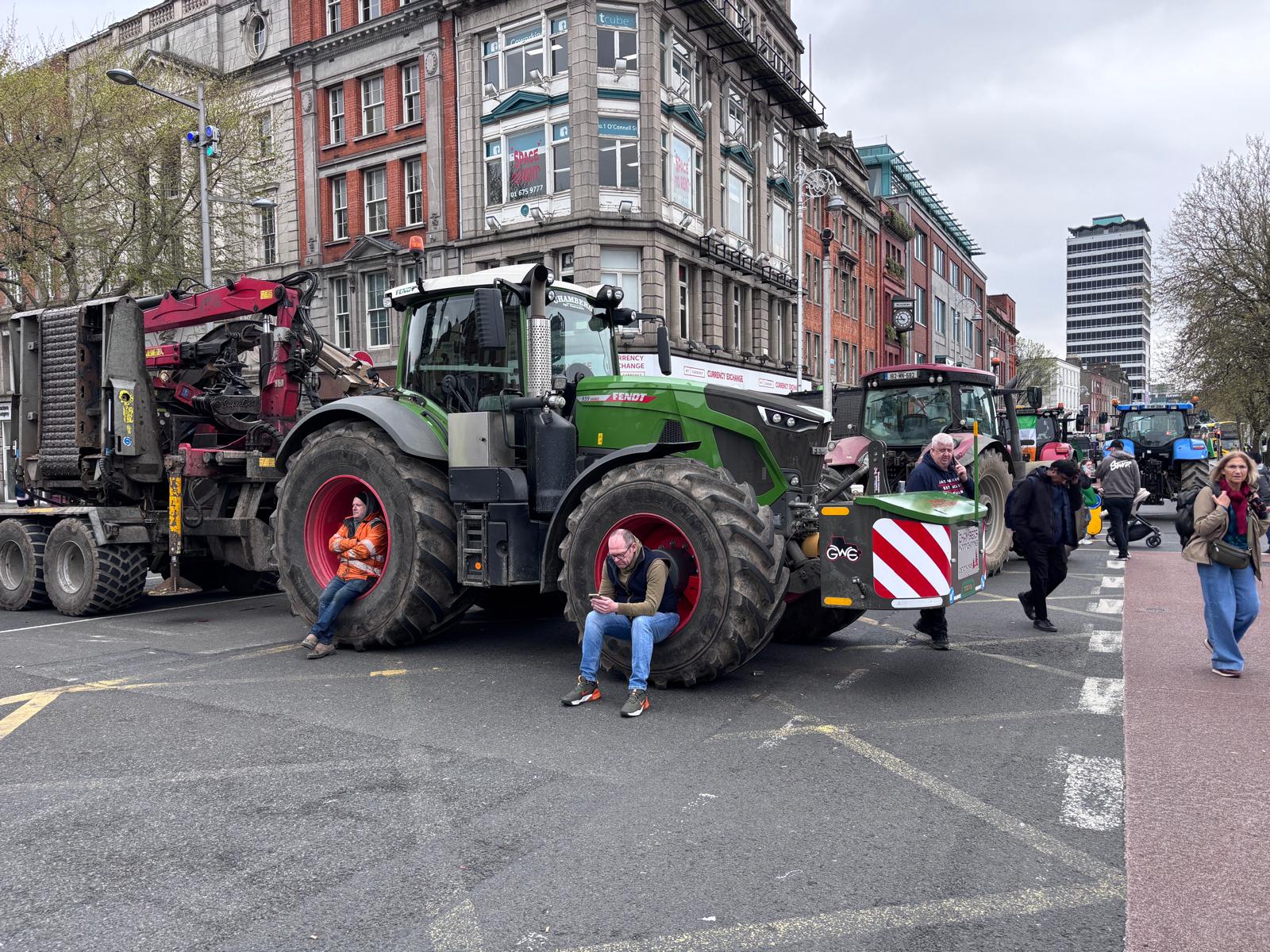
In Dublin city centre, protesters have held their positions overnight for a second consecutive day, leaving tractors, trucks and buses parked along O’Connell Street and the North Quays. The move has effectively blocked key routes through the city, with gardaí warning that further action today could include roadblocks affecting access to Dublin Airport and the Port Tunnel.
View this post on Instagram
Public transport remains heavily impacted. All buses travelling through O’Connell Street are diverted, with Dublin Bus previously warning of “very significant disruption” and major diversions across the network. The situation has been further compounded by blockages at O’Connell Bridge and along Eden Quay, placing additional strain on already busy routes, particularly on the E Spine and F Spine corridors.
Luas services continue to face disruption, with the Green Line not operating between St Stephen’s Green and Dominick Street due to vehicles obstructing tracks. Services are running only on limited sections of the line, while the Red Line remains operational.
The disruption in the capital forms part of a broader wave of protests across the country, with organisers confirming that 28 separate demonstrations took place nationwide on the first day of the protests, on April 7. Convoys of tractors, lorries and trucks have been used to slow traffic and block key infrastructure overnight, while some protesters have indicated they intend to remain in place until their demands around rising fuel costs are met.
Key fuel depots in Foynes, Co Limerick and Galway remain blocked, raising concerns about supply chains, while protesters have also maintained a presence on the M7 outside Limerick. In Clare, demonstrators are again gathering at Banner Plaza (Junction 12 of the M18), with plans to take to roads around Ennis and Shannon.
Against this backdrop, Dublin Chamber said businesses across the capital are now experiencing serious operational challenges, including delays to staff, disruption to deliveries and reduced customer footfall, as well as ongoing uncertainty for commuters.
Dublin Chamber CEO Mary Rose Burke said: “The current level of disruption is placing an unfair burden on businesses and workers who have no direct influence over the issues being raised. It is neither sustainable nor proportionate.”
She added: “The most effective way to achieve meaningful progress is through constructive dialogue. We are urging protestors to engage with policymakers and relevant stakeholders through established channels, where their concerns can be properly heard.”
The Chamber acknowledged the right to peaceful protest but warned that the current approach is having a disproportionate effect on the day-to-day functioning of the city and its economy.
View this post on Instagram
The Chamber acknowledged the right to peaceful protest but warned that the current approach is having a disproportionate effect on the day-to-day functioning of the city and its economy.
“Dublin is the economic heart of the country. Prolonged disruption not only affects individual businesses but also damages the city’s reputation as a place to work, invest and visit,” Ms Burke concluded.
Meanwhile, Transport Minister Darragh O'Brien said the Government will not negotiate directly with those involved in the protests, as he called for an immediate de-escalation.
He warned that businesses in Dublin are already experiencing financial losses due to the disruption and urged demonstrators to reconsider their approach.
“It is not acceptable that people are not allowed to go about their daily work, their daily lives and it is not acceptable that we have cities and towns turned into carparks, effectively,” he said.
“There are ways to put one's point across and I think most would agree the way of doing that is not to disrupt people's lives, hospital appointments, people going to work, public transport. That is not something that is acceptable.”
Mr O’Brien added that the Government engages with recognised representative groups rather than individual protest movements.
“Government only engages with national, recognised and representative bodies like the Irish Road Haulage Association and cannot respond to every single protest that happens.”
Describing the situation as unprecedented, he said authorities are urging protesters to stand down.
“This is unprecedented, what is happening right now,” he said. “This is a global crisis, every other country is impacted. Ireland, like every other country, is impacted and we will do our best to support people but the way of doing that is not to disrupt our own supply chains.”
He also stressed that while the right to protest is respected, there must be limits where wider society is affected.
“There can't be a situation that supplies are impacted on, people's daily lives are impacted on, and I would ask people to reflect on that.”
Speaking at a press conference outside Government Buildings this morning, Taoiseach Micheál Martin said it is “not acceptable” to “turn O’Connell Street into a car park”.
“The protests at the moment are wrong. To prevent mobility, to prevent people from accessing livelihoods, medical appointments, disrupting day-to-day activities in the manner that has happened is wrong, and is a wrong form of protest."
“And in my view, is not conducive to cohesion within our society or to resolving issues in a satisfactory manner,” he said.
He added that blocking roads “is not a legitimate form of protest”.“We respect people’s right to protest, and so there’s always a balance, initially, in terms of how that is policed, but what is not acceptable is people declaring that we will turn O’Connell Street into a car park.
“That’s not acceptable. There are people with businesses on O’Connell Street who need to survive,” he said.
With disruption ongoing in Dublin and across the country, commuters and businesses are being advised to expect continued delays, as the situation remains highly fluid.