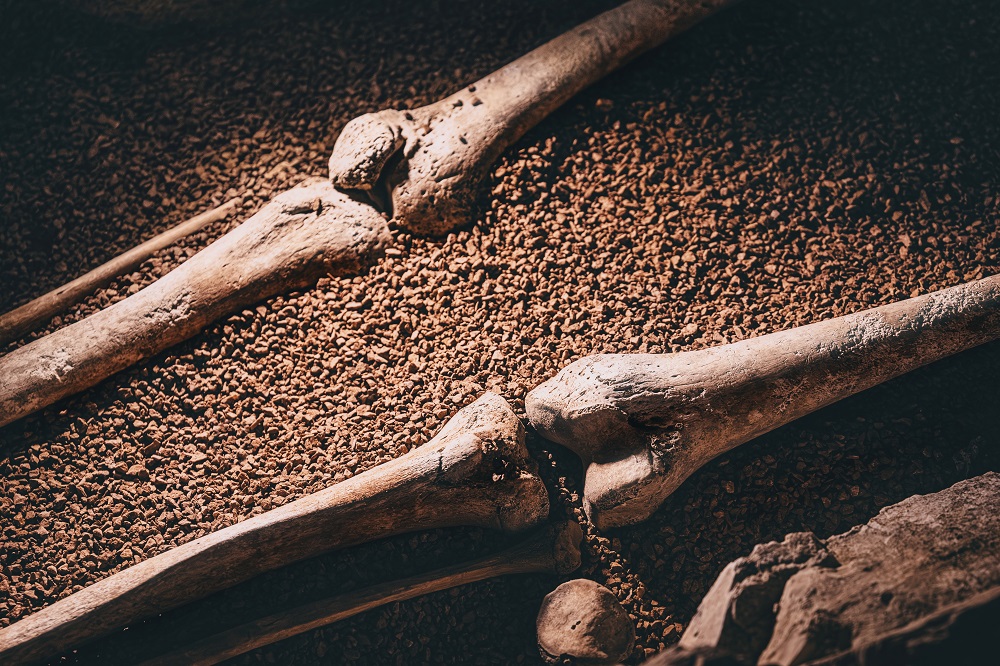

Human remains which were discovered in a megalithic tomb in Co Leitrim almost a century ago, can be traced back to 5,300-5,600 years ago.
The remains were found at Sheebeg near Keshcarrigan during an unlicensed excavation in Christmas week of 1930, and can be dated earlier than remains associated with Newgrange and Stonehenge, two of the best known prehistoric monuments in Ireland and Britain respectively.
The Sheebeg cairn, located in south Leitrim, has been associated in local folklore with Fionn Mac Cumhaill and with Turlough O'Carolan's composition Sí Bheag, Sí Mhór.
According to recent osteoarchaeological analysis and radiocarbon dating, the remains found in the cairn are those of an adult, probably a female from the early middle Neolithic period. These bones have been stored in the National Museum of Ireland since 1931.
Originally, the remains were found in 1930 by a local schoolteacher named John O'Hara, and amateur archaeologist and landowner, Peter O'Connell, with O'Hara later bringing them to the National Museum of Ireland the following year.
The bones were then re-examined by Mr O'Connell's grandson, Professor Peter Halligan, a neuroscientist, who sought permission from the museum to have the material fully assessed.
According to reports in RTÉ, Dr Niamh Daly, an Osteoarchaeologist, said that radiocarbon dating which was carried out at Queen's University Belfast, discovered "an individual roaming this landscape 5,600 to 5,300 years ago".
She went on to say that osteoarchaeological analysis carried out, had confirmed that these bones were human remains.
Dr Daly said: "We are looking at a date that is contemporary to the evidence we have from Carrowkeel and Carrowmore in Sligo but significantly earlier than the Boyne passage tombs, which is really interesting" (Quotes according to RTÉ).
She also said the mandibles examined belonged to an adult male and probably an adult female, while a number of loose teeth were found with the remains, including two which did not appear to belong to either individual found, which may suggest the presence of a third person.
Speaking about the remains, Dr Peter Halligan said that his interest in the bones found in the Sheebeg emanated from a strong family connection, as well as unanswered questions about what had been found.
"When I retired, I discovered that the bones were still there at the museum," he said. "But we didn’t know if they were animal or human".
He added: "I was told that they were human".
"That got me thinking that it would be interesting to find out who these people were".
He said that the cairn was excavated by his grandfather and Mr O'Hara, after reading about the site and its association, before the latter brought the remains to the Dublin museum.
This excavation took place eight months after the National Monuments Act 1930 came into effect, with Dr Halligan saying that this legislation was not widely understood locally at this time, and they were not prosecuted.
"It wasn’t a licenced excavation," he said, adding "the National Monuments Act came into effect in April 1930".
He said: "This was in December 1930. The OPW and gardaí at the time fully understood that most people didn’t know about it.
While he could conclude that the remains could not be those of Fionn MacCumhail, Dr Halligan said that he wanted to discover what his grandfather, who had a degree in archaeology, had found.
"It was an itch I wanted to resolve," he claimed, adding: "What was he looking at when he found it? It was a bit of closure".
Dr Halligan went on to say that he hopes that future generations will be able to understand the significance of these cairns, but also the questions they continue to raise regarding the people who lived in the area over 5,000 years ago.
"There are lots more questions," he said. "It’s only the start and by no means the end".
So far, seven middle Neolithic passage tombs were identified in the near vicinity of Sheebeg, near Keshcarigan.
According to archaeologist, Sam Moore, the new dating is important as it provides an early radiocarbon for a passage tomb in south Leitrim.
"It suggests that this place is significant in that it's older than places like the Boyne Valley, Knockroe in Kilkenny and the Mound of the Hostages in Tara", he said. "This is the middle of the Neolithic period. These are the first farmers in Ireland". (Quotes according to RTÉ).
"The Neolithic begins with the import of people with domesticated plants and animals".
"Where did the people come from? We don't really know".
"We know that the genetics are suggesting that they originate in Anatolia - modern day Turkey".
He added that further work will help archaeologists will gain a better understanding of the wider passage tomb landscape in the Sheebeg area.