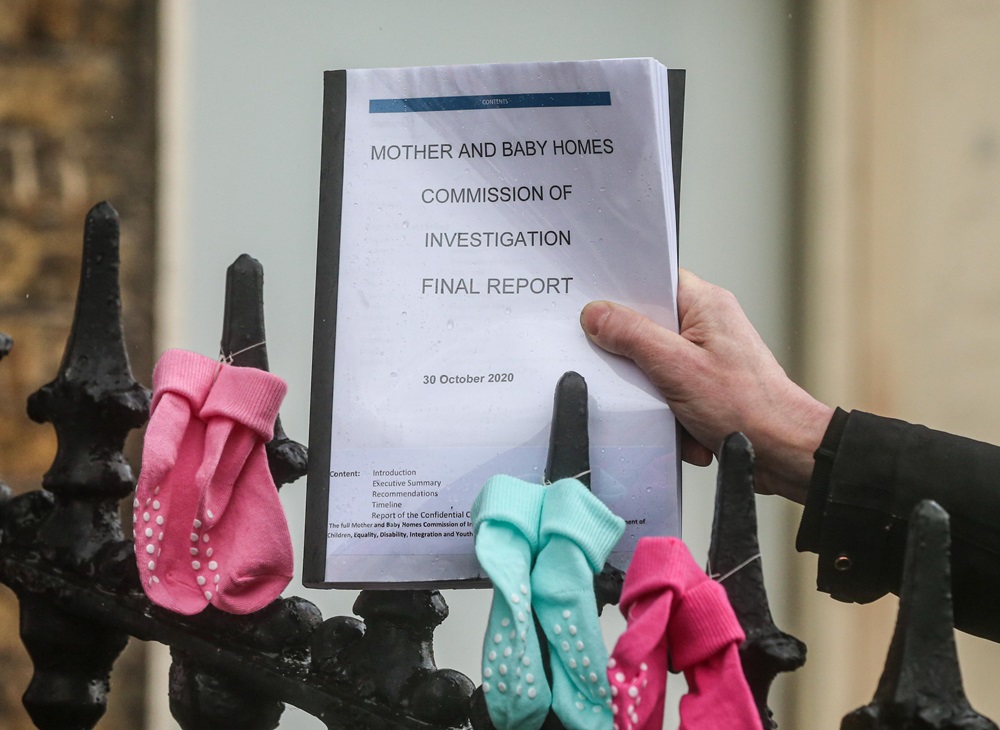

A solemn gathering will take place this Sunday at the gates of the former Bessborough mother and baby home, where survivors, advocates, and public representatives will read aloud the names of 923 infants and children who died while in the institution’s care or shortly after discharge. Organisers say the event is intended both as an act of remembrance and as a dignified protest following Cork City Council’s recent decision to approve a major housing development on the historic site.
The reading is being organised in direct response to the council’s late‑February decision to grant planning permission for 140 apartments on the grounds of the former convent. For many survivors, the land is regarded as a site of conscience, and the approval has caused deep distress among those still seeking answers about the fate of children who died there.
Bessborough was operated by the Congregation of the Sacred Hearts of Jesus and Mary from 1922 until its closure in 1998. Over those 76 years, 9,768 women and 8,938 babies were admitted. In 2018, figures released by the General Registry Office confirmed that 816 death certificates had been issued for children who died either at Bessborough or shortly after leaving the institution.
However, the final report of the Mother and Baby Homes Commission, published in 2021, identified 923 child deaths linked to Bessborough—107 more than previously disclosed. Despite this, burial records exist for only 64 of those children. The commission concluded that it was “highly likely” that some of the missing remains lie somewhere within the grounds of the former convent, though no comprehensive investigation has yet taken place.
Among those taking part in Sunday’s event is Social Democrats councillor Noelle Brown, who was born in Bessborough. She told The Echo that the council’s decision had sent “shockwaves” through the survivor community. For many, she said, the approval of new construction feels like an attempt to move on from a past that has never been fully acknowledged.
“The children and infants were denied respectful burials, and their mothers were denied the right to grieve,” she said. “A public reading is the least we can do so they will not be remembered as mere statistics.”
Organisers emphasise that Sunday’s gathering is intended to be peaceful, respectful, and focused on remembrance. Each of the 923 names will be read aloud at the main gates of the former institution at 1pm on Sunday, April 26, ensuring that the children are honoured individually, not lost to history.
Survivors of the former Bessborough mother and baby institution say they are “devastated” by Cork City Council’s decision to approve a major apartment development on the historic site, which many regard as a landscape of trauma and unmarked burials. The council has granted planning permission to Estuary View Enterprises 2020 for 140 apartments, despite previous refusals and long‑standing concerns that parts of the grounds may contain the remains of hundreds of children.
The decision has caused deep distress among survivors. Carmel Cantwell of the Bessborough Mother and Baby Home Support Group said members were “deeply saddened” that construction could proceed on what she described as a site of “profound national significance.” Her brother William, born in Bessborough in 1960, was buried in the old Famine graveyard at Carr’s Hill — information withheld from their mother for nearly six decades. She said the lack of a full forensic investigation into the grounds means vital questions remain unanswered. “In all, 859 children are unaccounted for. For this reason, no one should ever touch what remains of Bessborough,” she said.
Local representatives have also criticised the decision. Fianna Fáil councillor and former lord mayor Terry Shannon said it demonstrated how “out of touch” planners were with community sentiment. He argued that the land should be preserved both as a place of commemoration and as a much‑needed green space for the area. Labour councillor Peter Horgan noted that five of the 70 planning conditions relate to the potential discovery of human remains — a reminder, he said, that “this is not an ordinary site.”