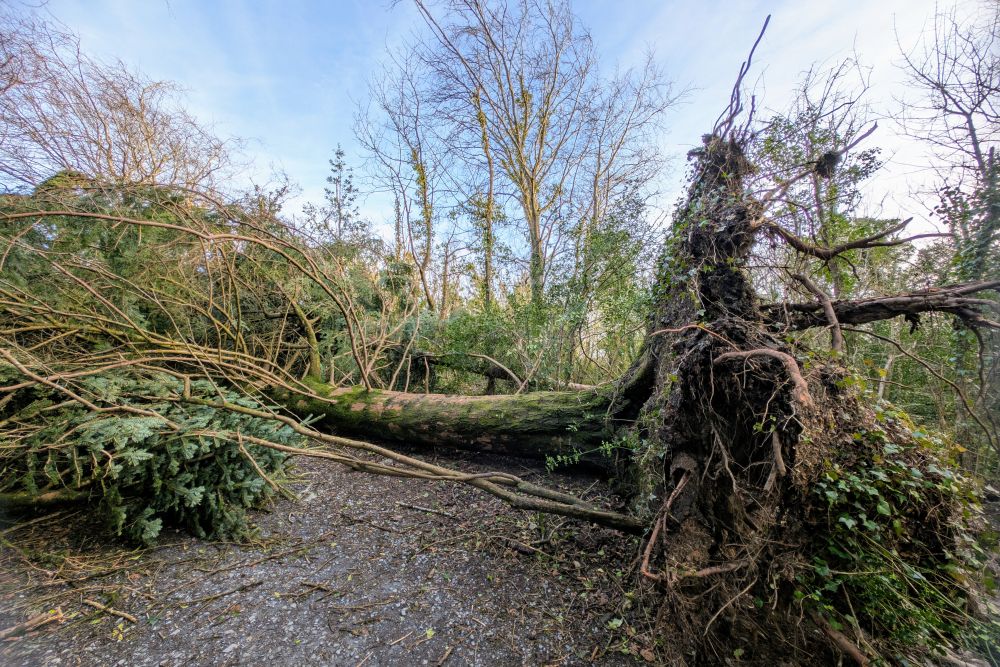

A new review following Storm Éowyn, one of the most destructive storms in Ireland’s recent history, recommends that public events should be cancelled in areas under Orange wind warnings.
Storm Éowyn, which struck in January, brought record-breaking wind gusts of over 184 km/h, causing severe and prolonged damage, particularly across rural and remote communities in the western seaboard, northwest, and midlands.
On Wednesday, the National Directorate for Fire and Emergency Management (NDFEM) released a detailed review, including several safety-focused recommendations for future extreme weather events.
“It is recommended that event organisers should cancel events in areas where an Orange wind warning threshold is forecast.”
“Event sites and funfairs with temporary structures of all kinds may need to be considered for closure at a lower threshold, which should be set by the event organiser at the event planning stage.”
“All event organisers should have arrangements in place to monitor wind speeds at the site of an outdoor event.”
The report notes that storms coinciding with large crowd events, such as music festivals or major sports fixtures, pose significant risks to public safety. It stresses that the timing of advanced warnings is key to enabling protective actions.
“It is normally possible to cancel sporting and other large crowd events in advance of a forecasted storm or an adverse weather event.”
“Sporting and event organisers would generally be expected to take a responsible and common-sense approach in the run-up to a forecasted storm.”
The review criticises the current regulatory framework, pointing out that under existing models:
“Public authorities may be advising against an event, but the decision to proceed or cancel rests with the event organiser.”
“For licensed events, public authorities should include a condition to planning for weather impact, including full closure and appropriate notification.”
However, most public events are unlicensed, leaving no clear mechanism, other than workplace health and safety legislation, to compel a cancellation due to weather.
At the storm's peak, 768,000 customers lost electricity, with weeks-long outages to power and water supplies. This required a humanitarian response at a scale well beyond any previous severe weather event, according to the NDFEM.
The cascading effects disrupted essential services and infrastructure.
Emergency hubs were activated to provide basic humanitarian support during the crisis. The report calls for expanding this system:
“The concept of emergency hubs needs to be further developed and reinforced so that they can be activated at short notice, providing a predefined level of support.”
“Local authorities proved to be best placed to coordinate and, where necessary, directly provide such hubs.”
However, the report acknowledges that not every community can be directly served by local authorities, and recommends that community organisations be supported to operate these hubs when needed.
You can read the review of the Storm Éowyn published by Gov.ie here.